
Lecture Series No.1 (November 12, 2023)
The video is available on Youtube.

<Click to enlarge>
Opening Address, by Yoshiyasu Iha, Co-chair, Voice of Okinawa and Ryukyu
Gusuyo, Chu uganabira - Hello, everyone. How are you today? Thank you for joining us out of your busy days for our first event by "The Association for the Voice of Okinawa and the Ryukyus." I hoped to deliver this opening address in the Okinawan language, but I had to receive a Japanese education, so allow me to speak in Japanese from here.
This year, it's been 78 years since the end of the Battle of Okinawa. Uchinanchu, as well as Yamatonchu, must always remember the tragedy of war. In 1985, 40 years after the defeat, German president Weizsacker said at the Parliament Memorial Park, "Those who close their eyes to the past are ultimately blind to the present as well."
In the Battle of Okinawa, Japan used Okinawa as its sacrifice stone to buy time for the defense of Japan and to protect its national structure. Hence, the fierce ground battle involved the residents, and one out of every four Okinawan lives were lost, destroying the rich nature and precious cultural assets.
Upon landing on Okinawa, the U.S. military not only seized the land of the war-displaced Uchinanchu but also evicted them from their homes and farms to build U. S. bases with bayonets and bulldozers. In 1951, Okinawa was used as a pawn in exchange for Yamato's independence, placed under the administration of the U.S. Since then, Okinawa has been used as a U.S. sortie base and logistical support hub for the Korean War, Vietnam War, and other U.S. wars of aggression. During that time, Okinawans have been forced to live with the U.S. military, facing repeated crimes, incidents, and accidents with lives lost and threatened. Human rights are trampled on.
Under such circumstances, Okinawans started to believe that a peaceful Okinawa without nuclear weapons and military would be restored if returned to Yamato, where the Peace Constitution was enforced. Okinawans launched the island-wide reversion movement.
The reversion to Japan was realized in 1972. Yet, the Yamato government decided that "the U.S. military bases would remain in place, besides the secret nuclear agreement. U.S. and Japan agreed that nuclear weapons could be introduced into Okinawa in the event of an emergency. The reality was far removed from the demands of the Uchinanchu people.
This year marks the 51st anniversary of Okinawa's reversion to Japan. During this period, the Yamato government has repeatedly stated that it will "work to reduce the base burden on Okinawa," even though 70% of all U.S. exclusive military facilities in Japan are concentrated in Okinawa, which accounts for only 0.6% of Japan's land area.
The return of Futenma, often called "the most dangerous air base in the world, also turned out to be contingent on the replacement facility in the coastal area off Henoko by landfilling the biodiverse-rich ocean. Okinawans have been opposing the plan, claiming that it strengthens the military functions. The 2019 prefectural referendum resulted in over 70 percent of Okinawans voting no to constructing a new base that landfills the sea, humankind's treasure. The Yamato government has been completely ignoring the voices of Okinawans. They froze their brain by parroting, "Henoko relocation is the only solution for the Futenma air station." The government even maneuvers its judiciary power to force the construction,
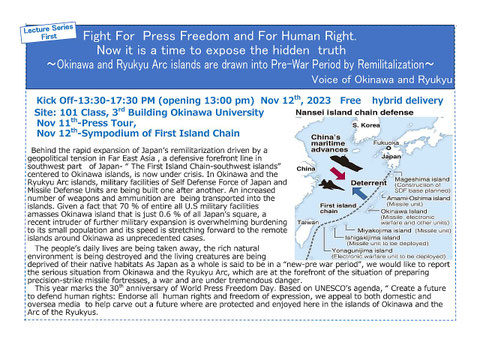
With the excessive concentration of U.S. military bases, an increase in the SDF deployment is occurring in Okinawa for the first time after the reversion. Responding to the intentions of the U.S. to deter rising China, the U.S.-subservient Yamato government has been agitating the public by saying "Taiwan contingency" is a "Japan contingency." They went ahead with the deployment of the SDFs and missiles on the islands of Okinawa and Ryukyu archipelago, destroying the residents' living and natural environment. The government ignores the voices of people who fear the islands will become targets of attacks in war. Now, the islanders' living environment is transforming into military fortresses. The situation is reminiscent of another "prewar" or "the eve of war."
Let us all, as sovereign citizens, raise our voices and take action to make Okinawa a center of peace by removing all military bases, based on our determination not to let Okinawa become a battlefield again and on the lessons learned from the Battle of Okinawa 78 years ago: "Life is a treasure" and "the military does not protect the people."
Dear media, please listen to the earnest voices of Okinawa and the Ryukyus and deliver our cries to people throughout Japan and the world. Please do not take up your pen for war again. Please do not let your ink flatter the power of the states. Let us stand together to protect freedom of expression and preserve peace through truthful reporting.
Thank you very much - Gusuyo, ippe niheydebitan.
Opening Remarks, by Dr. Hiroshi Yamashiro, President of Okinawa University
Today, on Sunday, November 12, 2023, I extend my gratitude to all those present at Okinawa University and those watching online for joining us on this precious holiday.
This symposium has been made possible through an invitation from Professor Emeritus Kunitoshi Sakurai, former President of Okinawa University, to the university-wide research project "Peace Studies for the Future of Life" research group, a part of the "Voices form Ryukyu-Okinawa" Association. Okinawa University is a co-sponsor, and our university is the venue for this event.
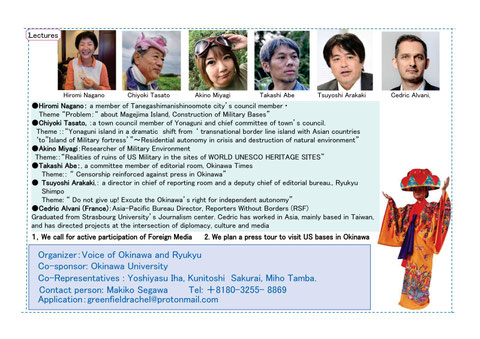
In the first lecture today, we will discuss the ongoing efforts in Yonaguni Island, Yanbaru Forest, and Mage Island to counter military fortifications and protect the natural environment. We will also highlight the endeavors of Okinawan media to voice their concerns about the Japanese media landscape. Additionally, Reporters Without Borders will share their perspective on Okinawa and the East Asia region. This symposium is just the beginning, as it will serve as the kickoff for a series of lectures by the "Voices form Ryukyu-Okinawa" scheduled for February 18.
Okinawa faces numerous issues, including peace, the environment, and human rights, all of which are growing in severity. Okinawa University has been passionately engaged in addressing these issues alongside those taking action in the region. Today's theme represents our commitment to the crises of peace, the environment, and human rights, and we believe that the University of Okinawa should lead the way in addressing them. Even more than 50 years after its reversion to Japan, Okinawa still grapples with problems stemming from structural discrimination. We firmly believe that Okinawa University exists to provide a space for learning, where people can easily recognize that global issues are interconnected with their own problems.
Our university's charter declares our commitment to engaging in various research and practices aimed at making Okinawa a region free from military bases to realize an independent and peaceful Okinawa. Today's lecture at Okinawa University is a significant step in this endeavor.
I would like to express my appreciation to all the symposiasts and participants for joining us today to discuss this important theme.
Closing Notes, by Dr. Kunitoshi Sakurai, Co-chair, Voice of Okinawa and Ryukyu
This is Kunitoshi Sakurai, co-chairman of the Association for the Voices of Okinawa and the Ryukyu Archipelago. First of all, I would like to thank for all the attendees in-person as well as online. Even though today is a Sunday, I appreciate that you joined our first lecture of the series "The media must expose the hidden truth for human rights! ~ the truth about Okinawa and the Ryukyu Archipelago facing a "new pre-war"! We are pleased to have a total of 140 participants, 80 in person and 60 online.
Today's symposium was organized by the "Okinawa Association for the Voice of the Ryukyu Archipelago " with the cooperation of Okinawa University, which is conducting a university-wide research project on "the Studies of Future Peace." We are very grateful to have been able to hold this lecture in Naha, that has an excellent geographical advantage, and we would like to express our deepest gratitude to the President Yamashiro and the people of Okinawa University. I will introduce the schedule for the second lecture of the series later. In fact, the second lecture will also be held at the University of Okinawa.
Today, the lecturers introduced peoples’ resistance against military fortification in Yonaguni, the Yanbaru Forest, and Mage Island in order to protect the natural environment. Moreover, we had voices from the Okinawan media that speak out the landscape of the Japanese media. The Reporters Without Borders lay out how the world views Okinawa and the East Asia region. We hope that it was a great opportunity for the audience to seriously consider about what is going on in Okinawa, the Ryukyu Archipelago and what that means.
By the way, this year marks the 30th anniversary of the World Press Freedom Day. According to the Reporters Without Borders, Japan ranks 68th out of 180 countries in the world in terms of press freedom. Compared to our neighbors South Korea, which is raked 47th, and Taiwan, which is ranked 35th, this is a very poor result. Japan’s rank of Press Freedom was 11th in 2010 when the Democratic Party of Japan (DPJ) was in power. However, Japan’s rank has plummeted under the Abe and Kan administrations. Although the media is supposed to be a watchdog of power, the Japanese media surrenders to the government and big advertiser. Okinawa is a clear case of the corruption of the Japanese media. This series was launched to break through this situation.
Nonetheless, it is not easy to break through this situation. I had learned about this fact when I planned the first lecture of this series. I would like to share our experience with you in order to be on the same page with you about the magnitude of the challenges we must overcome in the future.
We wanted to invite as many foreign media as possible to participate in this event, and we worked under the advice of Makiko Segawa, who is an experienced simultaneous interpreter for foreign media. We applied to the Foreign Press Center (FPCJ) for their international distribution service as well as to the Foreign Correspondents' Club of Japan (FCCJ) for a press conference. However, both organizations rejected our requests. Although the reason was not articulated, we infer from their explanations before our applications that they were afraid of delivering “too political messages.” If the theme we are trying to convey is too political, what on earth can we do? In any case, I think it is necessary to recognize once again that the media situation surrounding Okinawa and the Ryukyu Archipelago is extremely shuttered from the rest of the world.
As for our future plans, first, we are going to conduct the in-depth debrief of this symposium. Based on that, we will hold the second symposium at the University of Okinawa on February 18 next year. The theme of the symposium will be "the Civil Movement Against the Japanese Government's Forced Construction of the New US military base at Henoko.” The three lecturers will be Ms. Etsuko Urashima of the Council against the Helicopter Base, Mr. Hideki Yoshikawa of the Dugong Conservation Campaign Center and Environmental Justice Project, and Mr. Hiroto Tokuda of the University of the Ryukyus. We look forward to seeing you all there.
Everyone let’s work together and move forward step by step to open up the future of Okinawa and the Ryukyu Archipelago.
Thank you very much for your time today. I would like to conclude my closing remarks.
Speaker
Cédric Alviani
Asia-Pacific Bureau Director, Reporters Without Borders (RSF)
Thank you all for inviting me today. I regret that it was not possible for me to come in person to be with you in Okinawa. It has been too long since I didn't visit Japan, and I look forward to visiting you in person very soon.
1 - REPORTERS WITHOUT BORDERS (RSF)
Reporters Without Borders (RSF) is an international non-governmental, non-profit organisation that acts for the freedom, pluralism and independence of journalism and defends those who embody these ideals.
I want to insist that Reporters Without Borders (RSF) does not engage in politics, and that therefore all opinions I express today will be strictly limited to the topics covered by our association’s mandate, which are press freedom and the right to information. Nevertheless, we understand that journalists in Okinawa encounter serious pressure and intimidation when working on some topics.
The case of the island indeed combines many topics related to defence, culture, society, history, governance, environment, deemed sensitive in Japanese society. However, we believe that no topic of public interest should be considered as a national taboo, and that facts relating to the situation of Okinawa, as brought up by today's speakers, should and must be brought to the attention of the public, and discussed openly, without journalists being submitted to censorship, pressure or harassment.
So I would like to extend all our sympathy to all journalists who report on Okinawa, and especially the ones who are based in Okinawa, as they are the most exposed to retribution.
RSF, established in 1985, has a recognised public interest function and a consultative status with the United Nations, UNESCO, the Council of Europe, the International Organisation of the Francophonie and the African Commission on Human and Peoples’ Rights.
RSF’s actions:
・Denounce press freedom violations
・Support journalists (emergency assistance and capacity building)
・Work with stakeholders (journalists, civil society, governments, international organisations) to bring solutions.
2 - PRESS FREEDOM IN THE WORLD
Since 2002, the World Press Freedom Index evaluates the environment for journalism in 180 countries and territories. The environment for journalism is “bad” in seven out of ten countries, and satisfactory in only three out of ten. If we take in consideration the population, the ⅔ of humanity live under regimes that deprive them of their right to information, and less than 5 percent live in countries where these freedoms are perfectly respected.
The Nordic countries usually are on top, while the world’s leading parliamentary democracies are clearly recessing. Take a look at the G7 countries ranking: Canada 15, Germany 21, France 24, United Kingdom 26, Italy 41, United States 45, Japan 68.
The last three places are occupied solely by Asian countries: Vietnam (178th), which has almost completed its hunt of independent reporters and commentators; China (down 4 at 179th), the world’s biggest jailer of journalists and one of the biggest exporters of propaganda content; and, to no great surprise, North Korea (180th).
3 - SITUATION OF JAPAN
Japan ranks 68 out of 180 in our index. A parliamentary democracy, Japan upholds the principles of media freedom and pluralism. However, the weight of traditions, economic interests, political pressure, and gender inequalities prevent journalists from fully exercising their role of holding the government to account.
・Hyper concentration of the media (5 major conglomerates)
・The system of “kisha clubs” (discrimination and self-censorship)
・Harassment on journalists who criticize the government or cover subjects deemed “unpatriotic”.
・Heavy self-censorship on topics that could be deemed sensitive, such as corruption, sexual harassment, health issues (Covid-19, radiation), or pollution.
・Vaguely worded “national security” regulations that don’t take journalism into consideration journalism.
・A climate of mistrust since the rise to power of the nationalist right in 2012. In 2020, the government dramatically reduced the number of journalists invited to its press conferences, using Covid-19 health measures as an excuse.
4 - WORKING ON SOLUTIONS
A free press is a protection for citizens against potential abuse from government and private forces, so raising press freedom issues is not equal to disrespecting Japan but is actually a demonstration of care for the Japanese people. Japan is one of the world’s leading democracies, it bears a great responsibility. It is normal that the international community would expect the highest standards, and that NGOs like RSF would echo this request.
Being critical doesn’t exclude dialogue. RSF conducted a mission late 2018 to engage with the Japanese government; met the Prime Minister’s office and Ministry of Foreign Affairs. It was an opportunity to openly discuss how freedom of press can be protected and further improved. Interrupted by Covid 19 but will be resumed in the coming year.
We also invited Japan, its civil society and media outlets, to participate in the following initiatives:
・The International Information & Democracy Initiative aims to establish safeguards for freedom of opinion and expression in the global online information and communication space. This project is set to implement Article 19 of the Universal Declaration on Human Rights in the digital era through a forum that works on proposing solutions and spreading best practices. This project has been endorsed by 52 countries so far, and we hope that someday Japan will also join the initiative.
・The Journalism Trust Initiative (JTI) is a self-regulatory mechanism designed to promote reliable news and information sources. Approximately 1,000 media outlets, including major global media and national broadcasters, have already joined. Provides incentives for media outlets to optimise editorial processes, performance, and ethical conduct by providing competitive advantages. Enable consumers and citizens, regulators, investors, donors and the private sector, like advertisers and distributors to identify and reward trustworthy journalism.
・On November 10, 2023, RSF and 16 partners unveiled the Paris Charter on AI and Journalism, the first of its kind, that defines ethics and principles that journalists, newsrooms and media outlets around the world will be able to appropriate and apply in their work with artificial intelligence.
We’re looking for further cooperation with Japan and hope this will benefit press freedom and the right to information in Japan and also on a global level.
Thanks to our translator.
Reporters Without Borders (RSF) https://rsf.org/en
World Press Freedom Index https://rsf.org/en/index