
沖縄・琉球弧の声を届ける会
Voice of Okinawa and Ryukyu
2025.10.7
Voices of Okinawa and the Ryukyu: Lecture Series, Part 8
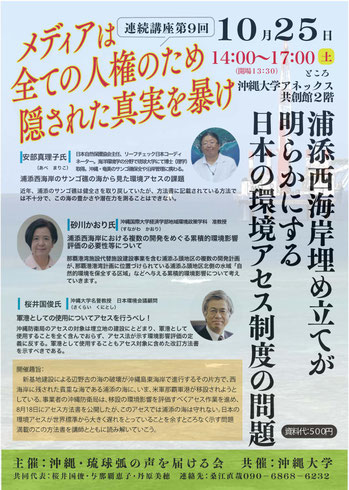
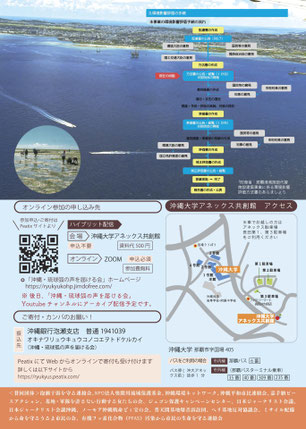
The Problems with Japan's Environmental Assessment System Revealed by the Urasoe West Coast Landfill Project
Purpose:
On the east coast of Okinawa Island, destruction of the sea continues due to the construction of the new Henoko base building. Meanwhile, on the West Coast, the beautiful and biodiverse Urasoe Sea is now threatened by the planned relocation of the U.S. military's Naha Naval Base. The Okinawa Defense Bureau, the project operator, is advancing environmental assessment work to evaluate the relocation's ecological impact and released the scoping document on August 18. However, this assessment cannot protect Urasoe's sea. Japan's environmental assessment process lags significantly behind global standards. Let’s find this fact by examining a problematic document together with our instructors.
Date: Saturday, October 25, 2025, 2:00 PM - 5:00 PM (Doors open at 1:30 PM)
Venue: Okinawa University Annex Kyoso-kan, 2nd Floor (405 Kokuba, Naha City)
(Approx. 400m south of Okinawa University Main Gate)
Organizer: Voices of Okinawa and Ryukyu
Co-organizer: Okinawa University
* No reservation is required for on-site participation.
A materials fee of 500 yen will be charged.
* Website:https://ryukyukohp.jimdofree.com/
* Online participation requires prior registration.
Registration:https://ryukyus.peatix.com/
Inquiries:[email protected]
Program: Lecturers, themes, and lecture summaries
Dr.Mariko Abe
Profile: Chief of the Nature Conservation Society of Japan, ReefCheck Japan Coordinator. Earned a Ph.D. in Marine Environmental Science from the University of the Ryukyus. Engaged in coral reef conservation and coastal management in Okinawa and Amami.
Theme: Environmental Assessment Problems Seen from the Coral Reef Sea off Urasoe's West Coast
Summary: In recent years, the coral reefs of Urasoe have been regaining their health. However, the methods described in the scoping document are insufficient and cannot measure the richness and potential of this sea.
Dr.Kaori Sunagawa
Profile: Associate Professor, Department of Regional Environmental Policy, Faculty of Economics, Okinawa International University
Theme: The Need for Cumulative Environmental Impact Assessment Regarding Multiple Developments on the Urasoe West Coast
Summary: This presentation examines the cumulative environmental impacts of multiple development projects in the Urasoe Wharf area, including the Naha Port Facility Replacement Project, on areas such as the “Natural Environment Conservation Zone” in the waters north of the Urasoe Wharf area, which is designated in the Naha Port Harbor Plan.
Dr.Kunitoshi Sakurai
Profile: Professor Emeritus, Okinawa University; Advisor, Japan Environmental Council
Theme: An Environmental Impact Assessment Must Be Conducted Regarding Its Use as a Military Port!
Summary: The Okinawa Defense Bureau's scoping document is limited to the construction of the landfill site and completely excludes its use as a military port, violating the definition of environmental impact assessment outlined in the Assessment Law. The Defence Bureau should present a revised scoping document that includes the use of the military port within its scope.
2025.7.26 News!
The media should expose hidden truths
for the sake of human rights for all!
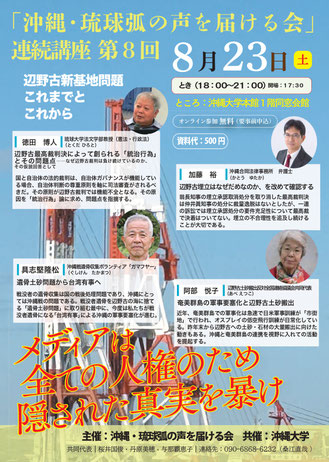
Voices of Okinawa and the Ryukyu: Lecture Series, Part 8
The issue of the new military base in Henoko:
the past and the future
Purpose:
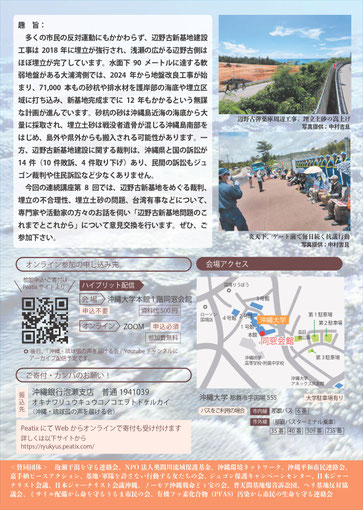
The construction of the new base in Henoko, which many citizens oppose, began in 2018 with the forced reclamation of land, and the reclamation has been completed on the Henoko side, where there are many shallow waters. On the Oura Bay side, where the soft ground reaches 90 meters below the water surface, ground improvement work is set to begin in 2024, involving the installation of 71,000 sand piles and drainage materials on the seabed. This reckless plan is expected to take 12 years to complete the new base. The sand for the sand piles is being extensively extracted from the seabed near Okinawa Island, and the landfill soil may be sourced not only from the southern part of Okinawa Island, where remains of war victims are mixed in, but also from outside the island and prefecture. Meanwhile, there are 14 lawsuits related to the Henoko new base construction between Okinawa Prefecture and the national government (10 lost, 4 have been withdrawn), and numerous private lawsuits exist, including the Dugong lawsuit and resident lawsuits.
In the eighth session of this series of lectures, we will hear from experts and activists about the legal battles surrounding the Henoko base, the irrationality of the landfill, issues related to the landfill sand, and the Taiwan contingency, and engage in a discussion on “The Past and Future of the Henoko Base Issue.” We encourage you to participate.
Date: Saturday, August 23, 2025, 6:00 p.m. to 9:00 p.m. (doors open at 5:30 p.m.)
Venue: Okinawa University Main Building 1st Floor Alumni Hall
Organizer: Voices of Okinawa and the Ryukyu
Co-organizer: Okinawa University
* No reservation is required for on-site participation.
A materials fee of 500 yen will be charged.
* Website: ⇒ https://ryukyukohp.jimdofree.com/
* Online participation requires prior registration.
Registration: ⇒ https://ryukyus.peatix.com/
Inquiries: ⇒ [email protected]
Program: Lecturers, themes, and lecture summaries
Dr. Hiroto Tokuda
Profile: Professor, Faculty of Law and Literature, University of the Ryukyus (Constitutional Law and Administrative Law)
Theme: “Governmental Acts” Created by the Supreme Court Ruling on Henoko and Their Problems —Why Has the Henoko Case Continued to Lose? A Hypothesis for an Answer—
Summary: In legal disputes between the national government and local governments, judicial review should be conducted based on the principle of respecting local government decisions when local government governance is functioning properly. However, this principle has failed to function in the Henoko case. This paper identifies the causes of this failure in the theory of “governmental acts” and points out the issues involved.
Mr. Yutaka Kato
Profile: Lawyer, Okinawa Joint Law Office
Theme: Reexamining Why the Henoko Landfill Project Is Unacceptable
Summary: While the Supreme Court ruling overturning Governor Onaga's revocation of the landfill approval stated that there was no abuse of discretion in Governor Nakaima's decision, the series of lawsuits have not yet reached a final resolution at the Supreme Court regarding the adequacy of the conditions for the landfill approval. It is crucial to continue pursuing the irrationality of the landfill project.
Ms. Etsuko Abe
Profile: Co-representative of the National Liaison Council Against Sand Transport to Henoko
Theme: The Militarization of the Amami Islands and the Transportation of Sand and Gravel to Henoko
Summary: In recent years, the militarization of the Amami Islands has accelerated, with U.S.-Japan military training taking place in “urban areas” and low-altitude flight training by Osprey aircraft becoming routine. Since late last year, there have also been movements toward the large-scale transportation of sand and gravel to Henoko. This activity aims to promote collaboration between Okinawa and the Amami Islands.
Mr. Gushiken Takamatsu
Profile: Volunteer for collecting the remains of war dead in Okinawa, co-representative of No More Okinawa War/Life is Precious Association, co-representative of Stop the War! Okinawa/West Japan Network
Theme: From the issue of soil mixed with the remains of war dead to the Taiwan contingency
Summary: The collection of war dead remains is a postwar issue for Japan, and for Okinawa, it is an issue related to the Battle of Okinawa. While we are dealing with the issue of disposing of war dead remains in the sea off Henoko, Okinawa, the Island is now being militarized in preparation for a “Taiwan contingency,” which could result in us becoming war dead remains ourselves.
supporting organization : Save Awase Tidal-flat Association, Okumagawa River Preservation Fund, Okinawa Environmental Network, Okinawa Peace Citizens Liaison Committee, Kadena Peace Action, Okinawa Women Act Against Military Violence, Save the Dugong Campain Center, Japan Congress of Journalists, Japan Congress of Journalists Okinawa, No More Battle of Okinawa : Nuchi du Takara Association, Anti-Helicopter Base Council, Uruma Citizen’s group to protect life from Missiles Installations, Liaison Association to Protect Citizens’ Lives from PFAS Contamination, Plaintiff Group for MCAS Futenma Aircraft Noise Lawsuit
2025.4.17
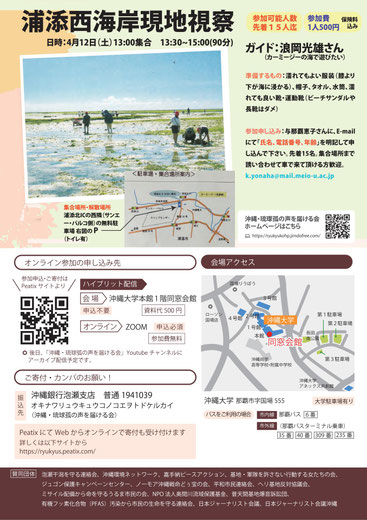
The 7th lecture series held on April 12 at the Okinawa University Alumni Hall had 63 on-site participants and 43 online participants. In addition, 17 participants attended the field observation session held in the afternoon of the same day with the cooperation of the "Kameezee's Sea Playgroup.
A recording can be downloaded from the link below.
lectures:0~1:55 and discussions 1:55~2:45 ⇒ https://youtu.be/rDr4krxXoBI
last part of discussions (10 minute) ⇒ https://youtu.be/J2spdvLmiqk
Handouts and lecture slides for the 7th meeting can be downloaded from the link below.
<Translated with DeepL.com (free version)>
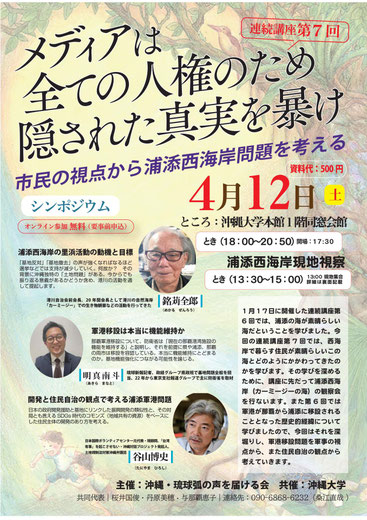
The Media must expose the hidden truth for the sake of all human rights!
Voices of Okinawa and Ryukyu. Series Lecture #7
Think about the Urasoe West Coast Issue from a Citizen's Perspective
Objective
In the 6th lecture series on January 17, we learned that the sea in Urasoe is terrific. In this 7th lecture, we will learn how the residents living on the West Coast have interacted with this fabulous sea. To deepen our learning, we will observe the west coast of Urasoe (Camiji) before the lecture. In the 6th session, we learned about the historical background of the relocation of the military port from Naha to Urasoe, and this time, we will delve deeper into this issue, considering the relocation of the army port from the military perspective and the perspective of resident autonomy.
Date: April 12, 2025 (Sat) 18:00~20:55 (doors open 17:30)
Venue: Alumni Hall, Okinawa University Main Building 1st floor
Hosted by: Voice of Okinawa and Ryukyu
Co-sponsored by; Okinawa University
Reservations are not required to attend. 500 yen is charged for materials.
Online participation requires advance registration.
For application ⇒ https://ryukyus.peatix.com/ <in preparation>
For inquiries, please get in touch with ⇒ https://ryukyus.peatix.com/
For inquiries, ⇒ [email protected]
The website is ⇒ https://ryukyukohp.jimdofree.com/
Program (18:00-20:55)
Zenro Mekaru: Former President, Minatogawa Neighborhood Association, Urasoe City
Theme: Urasoe West Coast Satohama Activities: Motivation and Goals
Summary: The more substantial the voices of “opposition to the base” and “base removal” become, the less support they receive in elections and other events. Why? Behind this is Okinawa's unique “land problem. This presentation will discuss the significance of looking back even now through the activities in Minatogawa.
Manato Akira: News Group, Tokyo Branch, The Ryukyu Shimpo
Theme: Is the relocation of the military port really to maintain its function?
Summary: The Ministry of Defense has explained that the relocation of Naha Military Port will “maintain the functions of the current Naha port facilities,” on this basis, the prefectural government and the cities of Urasoe and Naha have approved the relocation. Is it only a matter of maintaining the current functions? This report discusses the possibility that the relocation will lead to the strengthening of the base's functions.
Hiroshi Taniyama: Advisor, Japan International Volunteer Center
Theme: The Urasoe Military Port Issue from the Perspective of Development and Resident Autonomy
Summary: The similarities between Japan's official development assistance and base-linked promotion and development, as well as its counterpart, commons-based (locally shared resources) resident-led development in the age of the SDGs, will be discussed.
2025.2.11
The sixth lecture in the series, “Considering the Urasoe West Coast Landfill Issue,” was held on Friday, January 17, 2025, from 6:00 to 8:45 p.m. at the 3rd floor auditorium of the Okinawa Prefectural Museum & Art Museum. There were 70 on-site participants and up to 29 online viewers.
The video can be viewed on Youtube at
⇒ https://youtu.be/Oynh97jFjqs?si=3td9gV950U_T_4-3
Handouts can be downloaded from
⇒ Archive
2025.1.15
Translated from DeepL
Voices of Okinawa and Ryukyu Lecture Series No.6
Thinking about the Urasoe West Coast Landfill Problem
Objective:
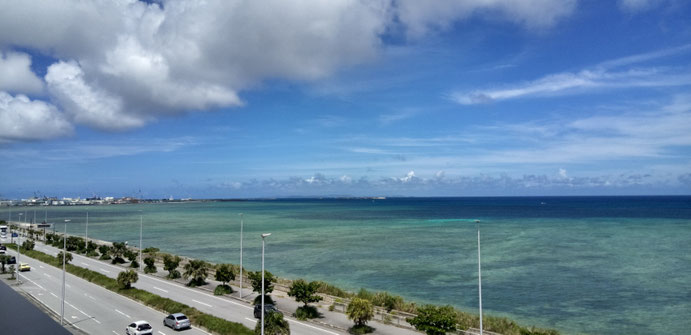
The purpose of this lecture is, first of all, to make everyone aware that the sea in Urasoe is indeed a wonderful sea. This is because the sea of Urasoe has been blocked by Camp Kinzer for a long time, and most local Urasoe citizens do not know the splendor of the sea in front of them. The second purpose is to learn the truth about the historical background (negotiations between Japan and the U.S.) that led to the relocation of the military port from Naha to Urasoe. Since many Urasoe citizens and Okinawans lack these basic understandings, the purpose of holding this series of lectures is to promote their understanding.
Date: Friday, January 17, 2025, 6:00 p.m. - 8:45 p.m.
Venue: Okinawa Prefectural Museum & Art Museum 3F Auditorium
Hosted by: Voice of Okinawa and Ryukyu
Reservations are not required to attend at the venue.
There will be a 499 yen charge for materials.
Online participation requires advance registration.
*For application ⇒ https://ryukyus.peatix.com/
*For inquiries, please contact ⇒ [email protected]
*The website is ⇒ https://ryukyukohp.jimdofree.com/
Program (18:00-20:45)
Dr.Mariko Abe, Chief of Conservation and Education Department, The Nature Conservation Society of Japan:
Coral Reefs in Urasoe and Environmental Assessment
Ms.Mayu Shikatani (Representative of Shikatani Nature Guide and co-chair of Satohama 22):
Marine Nature and Environmental Education in Urasoe
Mr.Yoshikazu Makishi (Architect, Okinawa Peace Citizens Liaison Group):
Urasoe Military Port Project since 1960s
Q&A Session
Summary of Lectures
Dr.Mariko Abe
The biodiversity-rich west coast of Urasoe is one of the few remaining healthy coral reef ecosystems on Okinawa Island. The avoidance and reduction of environmental impacts shown in the environmental assessment document is not concrete and lacks evidence. The reclamation plan should be reviewed.
Ms.Mayu Shikatani
What kind of nature exists in the sea of Urasoe and how has it changed in recent years? What is the role and value of coral reefs? She will introduce the significance of “environmental education,” which is necessary to understand these issues and to preserve nature, as well as her past activities.
Mr.Yoshikazu Makishi
On the west coast of Urasoe, Okinawa Prefecture, Naha City, and Urasoe City have a plan to build a new port, which includes a military port for the U.S. military. This military port plan was drafted by the U.S. military in the 1960s. We will clarify this U.S. military plan based on U.S. military documents.